$47.98
$88.76
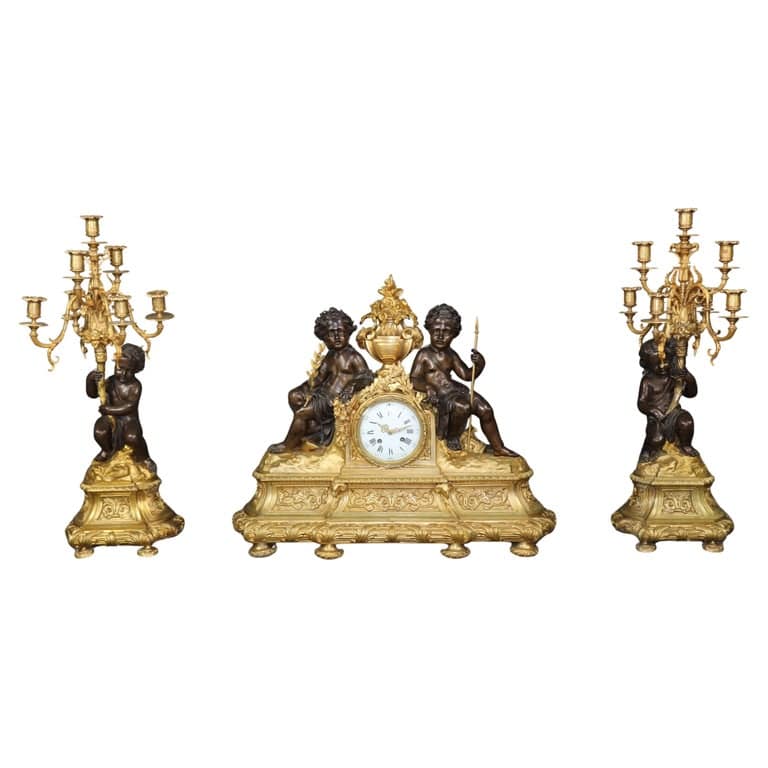
There are clock sets that politely sit on a mantel, minding their own business… and then there are clock sets that move in like French aristocracy—three pieces, full entourage, and absolutely no intention of whispering. This magnificent late 19th century French bronze figural clock garniture, signed “Millard à Paris,” is the kind of ensemble that turns a room into a stage and makes every visitor unconsciously straighten their posture. At center: a grand gilt bronze mantel clock, built on a sweeping base of deeply chased scrollwork, shells, and acanthus—pure Napoleon III / Louis XV Revival drama. The surface isn’t merely decorative; it’s sculptural, with crisp modeling that catches light the way good ormolu should—warm, dimensional, and unapologetically lavish. The white enamel dial with Roman numerals reads cleanly and elegantly, framed by an ornate bezel that announces, in no uncertain terms, that time here is meant to be admired. And then come the figures—two richly patinated bronze putti, dark and satiny against the gold ground, lounging like mythological interns assigned to the department of “Allegory.” One carries a torch (enlightenment, aspiration, possibly mischief), the other a laurel (victory, honor, and the subtle reminder that your bookshelf could be doing more). Above them, a classical urn and flaming finial crown the composition, giving the whole centerpiece a vertical flourish worthy of a Paris salon. Flanking the clock: a matching pair of figural candelabra, each anchored by a patinated bronze cherub supporting an exuberant spray of gilt bronze candle arms. The branches curl and rise with that unmistakable 19th century French confidence—symmetrical, theatrical, and engineered to make candlelight dance across gilded surfaces and mirrors like gossip at a soirée. Who was “Millard à Paris”? “Millard à Paris” is a horological signature associated with Paris clockmaking—most notably linked to the Millard family of makers active earlier in Paris; Denis Millard is documented as a Paris master horologist around 1700, and his name appears in auction and catalog descriptions of French timepieces. In the 19th century, it was common for Paris retailers/horologists to place their names on dials while collaborating with specialized case makers and foundries—so the signature functions as a mark of Parisian trade pedigree as much as authorship. Japy Frères If you owned a French clock in the 19th century, there’s a very good chance the heartbeat inside it said Japy Frères. Founded in 1777 by Frédéric Japy in Beaucourt, France (near the Swiss border), Japy Frères became one of the most important and industrially advanced clock and watch movement manufacturers in Europe. While Paris supplied the glamour—the gilt bronze cases, the porcelain dials, the theatrical putti—it was often Japy Frères supplying the mechanical soul. What Made Them Important? In the late 18th century, Frédéric Japy revolutionized horology by introducing mechanized production techniques. Instead of hand-making every tiny gear and pinion, he adapted industrial processes to produce interchangeable clock components. This dramatically lowered costs and increased consistency. By the 1800s, Japy Frères was producing clock movements on a scale that was unheard of in France. Measures 24.75 tall x 30 wide x 8.25 deep candelabras measure 30 tall x 12.75 wide x 12.75 deep. Condition report Age-appropriate wear for antique and vintage pieces. For a more detailed report please call 215-749-2104, or email:
[email protected] Additional Information: For national and international shipping quotes, special offers, or to schedule a showroom visit please call 215-749-2104, or email
[email protected]